

Autism and Pattern Recognition - Predictive Processing and Neural Networks
A contemplative consideration

Introduction
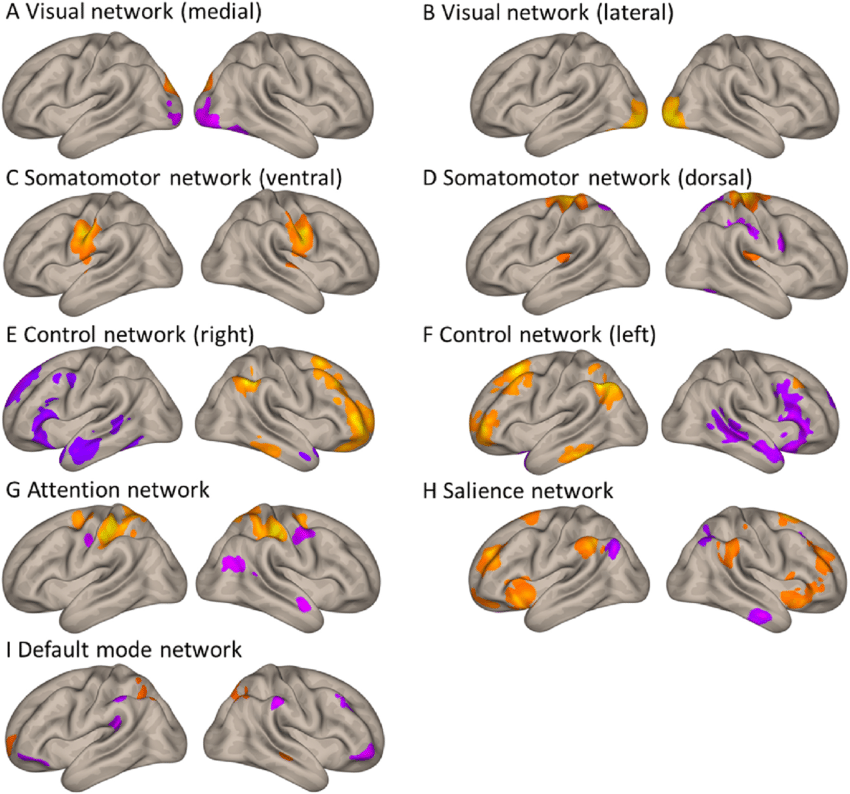
Autism Spectrum Disorder (ASD) is characterized by a diverse range of cognitive and behavioral traits, one of which is an enhanced ability in pattern recognition. This ability, while often a strength, is linked to atypical neural processes in the brain. Central to understanding these processes are the Default Mode Network (DMN), the Salience Network, and the Executive Control Network, which together shape how individuals with autism perceive, process, and respond to the world.
This article explores how these brain networks, guided by the framework of predictive processing, contribute to the unique cognitive profile seen in autism.
Pattern Recognition and Predictive Processing
Pattern recognition involves the ability to identify regularities and sequences in sensory input. In individuals with autism, this ability is often heightened, enabling remarkable skills in areas like mathematics, music, and visual arts. A key concept that helps explain this phenomenon is predictive processing.
Predictive processing posits that the brain is constantly generating predictions about incoming sensory information based on prior experiences. When sensory data is received, it is compared against these predictions. If the sensory input aligns with expectations, processing continues smoothly. However, if there is a mismatch—a "prediction error"—the brain updates its internal models to reduce future discrepancies.
In autism, the process of predictive processing may be atypical. Research suggests that individuals with autism might assign unusually high precision to prediction errors, leading to frequent updates of internal models. This could explain the enhanced sensitivity to patterns and details, as well as the difficulties in managing unpredictable or ambiguous situations. For instance, a study by Di Martino et al. (2011) found that children with autism exhibit aberrant connectivity in the striatum, a brain region involved in processing patterns, which may contribute to their superior performance in tasks requiring the recognition of sequences and regularities.
(I have a patreon where you can access a library of resources as well as ongoing education)
The Default Mode Network (DMN) in Autism
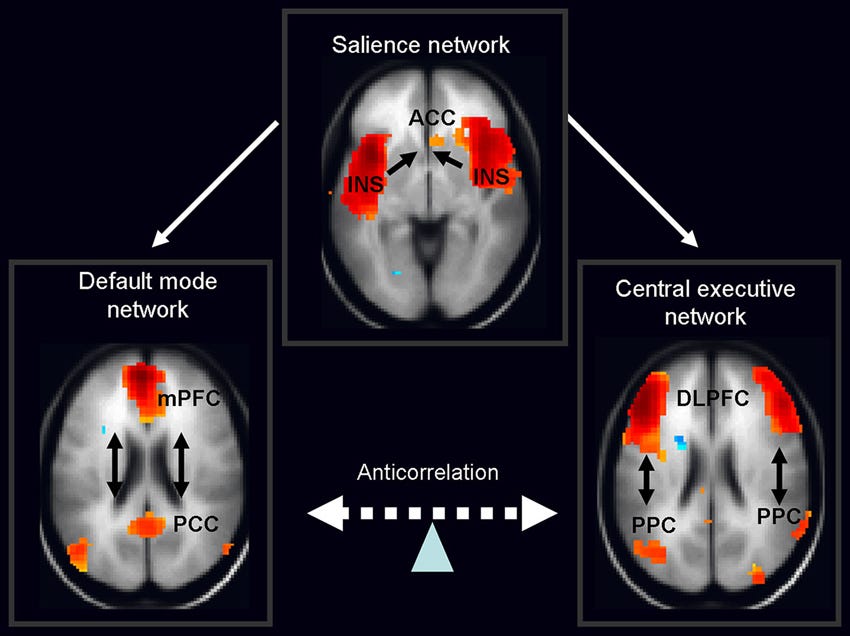
The Default Mode Network (DMN) is a key brain network involved in self-referential thinking, daydreaming, and the processing of social information. In individuals with autism, the DMN often exhibits atypical connectivity, which can impact how these cognitive processes unfold.
A comprehensive review by Harikumar et al. (2021) highlights the mixed patterns of connectivity observed in the DMN of individuals with autism. Some studies report hyperconnectivity in certain DMN regions, while others find hypoconnectivity, particularly in areas associated with social cognition, such as the medial prefrontal cortex and posterior cingulate cortex. This variability may contribute to the distinct cognitive profiles seen in autism, where heightened focus on details and patterns is accompanied by challenges in social interaction and self-referential thought.

Actually Autistic - Default Mode Network as CMY
The Role of the Salience and Executive Control Networks
Beyond the DMN, the Salience Network and the Executive Control Network also play critical roles in the cognitive functioning of individuals with autism.
The Salience Network acts as a switchboard in the brain, detecting and filtering important stimuli and facilitating the transition between the DMN and the Executive Control Network. In autism, the Salience Network may function atypically, leading to an intense focus on specific details or patterns while potentially overlooking broader contextual information. This could help explain why individuals with autism often excel in pattern recognition but may struggle with tasks that require shifting attention or integrating complex information.
The Executive Control Network is responsible for higher-order cognitive processes such as decision-making, working memory, and attention regulation. Disruptions in this network may contribute to the challenges individuals with autism face in managing tasks that require flexibility and adaptability. However, these disruptions might also reinforce the ability to maintain focus on detail-oriented tasks, further enhancing pattern recognition skills.
Research by Chen et al. (2016) supports the idea that the frequency-specific resting-state functional connectivity in autism reflects a more finely tuned but narrowly focused cognitive style, linking these neural differences to the unique cognitive strengths and challenges seen in ASD.
Interplay Between Networks: A Unique Cognitive Profile
The interaction between the DMN, Salience Network, and Executive Control Network creates a unique cognitive profile in individuals with autism. While these networks are often seen as separate entities, they work together to shape how the brain processes information. In autism, the atypical functioning of these networks, combined with altered predictive processing, may lead to both the strengths in pattern recognition and the challenges in social cognition and executive functioning.
Padmanabhan et al. (2017) noted that the DMN in autism is often less synchronized with other brain networks, which could explain the challenges in integrating social information with internal cognitive processes. This decoupling might allow for more focused processing of sensory information, thereby enhancing pattern recognition abilities while simultaneously contributing to broader cognitive difficulties.
Conclusion
The study of pattern recognition and neural networks in autism reveals a complex interplay between cognitive strengths and neural differences. The predictive processing framework provides valuable insights into how these strengths, particularly in pattern recognition, emerge from the unique way the autistic brain processes information. By understanding the roles of the DMN, Salience Network, and Executive Control Network, researchers can better appreciate the diverse cognitive profiles seen in autism and develop targeted interventions that support both the strengths and challenges associated with the condition.
Patreon!
If you found this content valuable and want to support more in-depth explorations of cognitive science, autism, and the brain, consider joining my Patreon community. By becoming a patron, you’ll get exclusive access to bonus content, early previews of upcoming videos, and the opportunity to participate in Q&A sessions where we dive deeper into the topics you care about. Your support helps me create high-quality content that educates and inspires. Click the link below to join the community and let's continue this journey together!
References
Di Martino, A., Kelly, C., Grzadzinski, R., et al. (2011). Aberrant striatal functional connectivity in children with autism. Biological Psychiatry, 69(9), 847-856.
Harikumar, A., Evans, D. W., Dougherty, C. C., Carpenter, K. L. H., & Michael, A. M. (2021). A Review of the Default Mode Network in Autism Spectrum Disorders and Attention Deficit Hyperactivity Disorder. Brain Connectivity, 11(4), 253-263.
Padmanabhan, A., Lynch, C. J., Schaer, M., & Menon, V. (2017). The default mode network in autism. Biological Psychiatry: Cognitive Neuroscience and Neuroimaging, 2(6), 476-486.
Chen, H., Duan, X., Liu, F., et al. (2016). Multivariate classification of autism spectrum disorder using frequency-specific resting-state functional connectivity: A multi-center study. Progress in Neuro-Psychopharmacology & Biological Psychiatry, 64, 1-9.